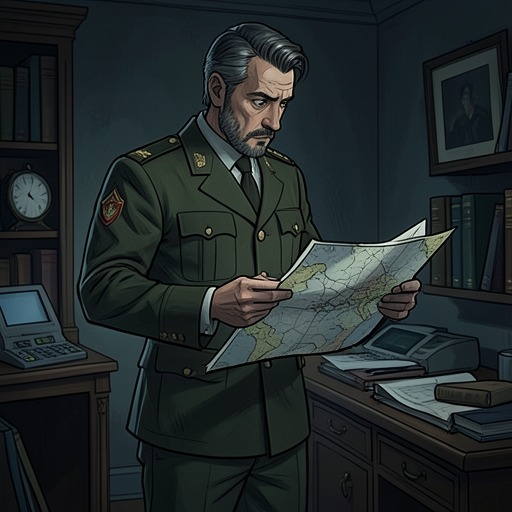
Regnar expedition attack
The InvincibleRegnar expedition attack is the decisive disaster that overtakes Regnar’s expedition in a volcanic crater on Regis III. It begins as a rescue operation prompted by the apparent cessation of combat, but ends with eighteen damaged survivors, four missing men, and no visible enemy. The attack’s most disturbing feature is not physical destruction alone: it reproduces the condition earlier associated with Kertelen, leaving people alive yet unable to recognize their rescuers or speak coherently. The event therefore exposes the limits of the expedition’s weapons, sensors, and categories of explanation while forcing Rohan and Horpach to reconsider whether they are facing an opponent at all.
Causes and Background
The expedition’s attack follows a growing accumulation of unexplained evidence. Regis III appears to be an extremely old planet, perhaps six billion years old, orbiting a sun already near the end of its life. Land life disappeared millions of years ago, while the ocean may still contain algae or other organisms capable of producing the atmosphere’s oxygen. Geological investigations found ancient metallic deposits embedded in the crust, including ruddy-black seams that may have originated from enormous quantities of metal fragments and that occur in remote parts of the planet as well as near the ruins. The extinction of terrestrial life coincided with the appearance of these strata, although the recorded radiation was far too limited to explain such a biological collapse.
The scientific picture became more unsettling when drilling revealed rusted fragments resembling microscopic mechanisms. A biologist later proposed that a rocket from another system might have landed on Regis III millions of years earlier and that mechanical forms, once created by rational beings, could have continued evolving after their makers vanished. In this hypothesis, the planet’s land is not empty but occupied by a mechanical ecology, while biological life remains confined to the ocean. Rohan had earlier suggested concealed aquatic beings and an underwater civilization, but the captain rejected the idea as implausible. The attack on Regnar’s expedition gives the mechanical-evolution hypothesis new force because its effects resemble neither ordinary combat nor a conventional biological assault.
The immediate background is tactical. Rohan infers that two aircraft have ceased using their weapons, since the Invincible’s sensors would have detected laser or induction-cannon fire from hundreds of miles away. He prepares through the night, checking the supercopter’s systems and loading additional fuel, supplies, and weaponry. The seven-thousand-tonne craft takes off at dawn, climbs to roughly nine miles to reach the stratosphere, and heads northeast in the hope of reducing the danger posed by the black cloud. Less than an hour later it lands in a sand-filled crater.
What Happens
From an altitude of fifteen hundred feet, Rohan, Gaarb, and Ballmin identify a geometrically arranged group of vehicles in the crater: small rectangles surrounding a larger steel-gray one. The formation belongs to Regnar’s expedition. Rohan lands nearby and sends out two reconnaissance vehicles protected by a mobile force field. The crater is shaped like a shallow bowl with a jagged rim, and its central volcanic cone is coated in ruddy-black lava.
The approach initially appears controlled. Radio contact is clear, and Gaarb’s vehicle moves ahead. He announces that a smoke flare is being sent as a greeting, then tries to establish contact with the people on the ground. His voice changes from routine communication to confused shouting. The engines of the vehicles cut out; running footsteps, muffled exclamations, and successive cries come over the radio before everything falls silent. Rohan repeatedly calls for Gaarb, hearing footsteps approach and a creaking sound, but receives no immediate explanation.
Gaarb finally answers in a breathless, altered voice. The condition of the expedition is the same as that previously suffered by Kertelen: the men are unconscious, do not recognize the rescuers, and cannot speak. Gaarb and the others examine them one by one, finding that the condition appears widespread rather than confined to a single victim. The attack is thus presented through interrupted sound and failed communication before the rescuers can see its human consequences, making the absence of a visible assailant part of the event itself.
An hour later, the survivors are brought beneath the hull of the supercopter in a ghastly procession. Of the twenty-two members of the expedition, eighteen remain; Regnar, Bennigsen, Korotka, and Mead are missing. Most of the survivors submit passively, but five resist so strongly that they must be carried away by force. Five stretchers are taken to an improvised sick bay, while thirteen others are placed in a separate cabin. Their masklike faces alarm the rescuers, and they are so helpless that other people must undress them and remove their boots. Most lie calm and passive; several of those who had resisted wail in eerie voices.
Rohan leaves the survivors to the physician and uses the abandoned vehicles to send his own team in search of the missing four. When he reports to Horpach, the commander immediately asks who is absent. Rohan names Regnar, Bennigsen, Korotka, and Mead, then asks about the aircraft and the black cloud. Horpach has no information about the planes, so the rescue remains incomplete and the mechanism of the attack remains unidentified.
Consequences and Investigation
The attack changes the meaning of the expedition’s mission. It is no longer simply a search for missing personnel or an attempt to explain the destruction of the Condor. The survivors’ condition suggests a recurring process that can disable human consciousness without leaving an ordinary battlefield. The earlier wreckage of the Condor had shown spectacular physical disorder: shattered instruments, powdered safety glass, torn books, scattered microfilm, and a mummified body. Yet the investigators had also found untouched food stores and soap marked by human teeth, details that resisted a simple account of hunger, panic, or mechanical damage. Regnar’s catastrophe extends that pattern of incomprehensibility from a dead ship to living people.
The rescue also produces a practical crisis for the Invincible. When the cruiser later lands in the crater near Regnar’s former base, it brings Rohan’s survivors inside its perimeter, but the ship’s sick bay has no room left; two additional cabins must be converted into hospital rooms. The survivors are physically in good condition but lethargic. Scientists then confront a particularly troubling question: why had Rohan and Jarg been spared, along with Terner until the later incident involving a mad shooter, when their clothing, weapons, and appearance were no different from those of the others? Their presence in a small amphibian craft seems too insignificant to explain the distinction, leaving survival itself as an unresolved clue.
Horpach considers whether the available evidence is sufficient to justify abandoning Regis III. The fate of the Condor and the attack on Regnar’s expedition already provide grounds for returning to base, but the commander still wants certainty rather than a collection of hypotheses. He seeks samples of the flying mechanical fauna, if such formations truly exist, both to establish the facts and to determine whether they might eventually threaten space travel in the region. The expedition’s military posture therefore persists even after the immediate rescue: knowledge is pursued through capture and material proof, and the possibility of danger is measured on timescales extending hundreds of thousands or millions of years.
Interpretation and Significance
The event intensifies the conflict between two explanations of Regis III. One treats the attack as the work of an enemy with intention, making retaliation, defense, and eventual annihilation seem rational. The other treats the attackers as products of inanimate evolution: remnants of a vanished technology that have become part of the planet’s natural forces. If the latter view is correct, then revenge for the Condor or Regnar’s expedition would be as misplaced as punishing the ocean for sinking a ship. The beings would not be choosing hostility; they would simply be enduring and acting according to their own survival processes.
Horpach accepts that this interpretation would make sense if it could be established, but he refuses to let an attractive hypothesis replace evidence. His insistence on an accurate diagnosis preserves the expedition’s scientific discipline while also revealing its danger: the demand for certainty may require further exposure to the force that has already killed or incapacitated so many people. The attack thus makes investigation ethically unstable. The same instruments that promise understanding can become instruments of intrusion, sampling, and possible escalation.
For Rohan, the catastrophe contributes to a wider moral reversal. The expedition arrives equipped with powerful weapons and assumes that anything incomprehensible may have to be defeated. After witnessing the ruined Condor, the incapacitated survivors, the ancient metallic strata, and the absence of any conscious enemy, he comes to see humanity’s confidence in conquest as both rash and unjustified. Regis III has maintained an equilibrium over millions of years, and its mechanical forms are no better or worse, in his emerging judgment, than biological organisms. The attack on Regnar’s expedition is therefore not only a military disaster; it is the scene in which human categories of enemy, responsibility, and rightful retaliation begin to fail.
The event’s decisive irony is that rescue succeeds only partially. Eighteen people are recovered, but four—including Regnar—remain missing; the living are returned without ordinary recognition, and the rescuers gain no clear account of what happened. The expedition’s apparent victory in reaching the crater produces neither mastery nor knowledge. Instead, it leaves the crew with a damaged human community, an unresolved planetary mechanism, and the growing realization that Regis III cannot be understood merely as a battlefield populated by hostile minds.